






Our brain identifies emotional pain and physical pain in the same way since negative emotional states and physical pain are connected. Emotional pain is real and should not be dismissed. But we can find positive ways to manage it.
What happens in our brain during emotional regulation
Our brain receives information about emotions from different areas in the brain and informs the Amygdala. The amygdala is responsible for emotional arousal and the fight, flight and freeze reactions. From the amygdala the information is sent to different areas including motor area, speech and the thinking rational brain to make sense of the situation. This information is then sent to the Anterior Cingulate Cortex (ACC) where cognitive, emotional and somatosensory information is processed.
The ACC and the thinking brain is also the pain pathways which is involved in releasing dopermine that can help to moderate pain perception.
When a situation is catastrophized it has a negative effect on the pain pathways and arouses negative emotions. Hence it is very useful to activate our rational mind in managing pain.

Persistent Pain
When pain is not processed in a helpful manner it can cause long term change to the ACC. Repeated fear activity can lead to anxiety which contributes to persistent pain.
What can we do about persistent pain
Dialectical Behavior Therapy, created by Prof. Marsha Linehan is often used to help people who are struggling with very reactive emotions and get hurt easily. They may had had a chaotic, invalidating childhood environment and suffered from trauma.
To help them, it’s important that they learn to accept their emotions while learning the right coping methods to regulate negative emotions.
Some skills that are emphasized in DBT:
(1) Learn to bear with emotional pain in a helpful manner (Distress Tolerance)
Pain is part of life and we cannot avoid it completely. Learning not to react impulsively to unfavourable circumstances and demand that it must be different is a start.
Here is what you can do
Distraction (ACCEPTS)
- Find activities that you can focus on and that will distract you from the painful emotions
- Do something to contribute to the community or help a friend in need.
- Compare yourself to people who are less fortunate. Or compare your emotions to another situation that was much worse
- Do things that will stir up positive emotions
- Say ‘no’ to those negative thoughts and push aside the emotions
- Repeat positive thoughts in your mind, replay a movie or song that is encouraging
- Sensory distractions such as exercising, listening to loud music or hold an ice in your hand.
Change your physical condition (TIP)
Changing body chemistry can help reduce the effect of overwhelming emotions
- Do intense exercise
- Wash your face or take a shower
- Controlled breathing – Breath in 5 counts and breath out in 7 counts.
Self-soothing
- Find activities that would sooth you
- Activate your five sense. Ask yourself what can you see around you, what can you hear, smell, taste and touch.
Problem Solving
- Ask yourself what exactly is the problem, what is happening and not happening. Where did it happen, when did it happen, how did it happen, How often does it happen, How do you feel and respond to it. What you need to change
- How does the problem interfere with your goal
- Find 3 possible solutions and the consequences of each option
- Identify the steps needed to take action and evaluate the results
Radical acceptance
Is letting go of bitterness and accepting the situation as it is. Life can be worth living despite the pain.
(2)Regulate the Emotions
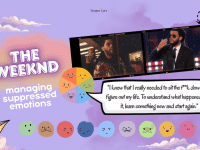
Emotional regulation is NOT about suppressing emotions. It is about recognising and understanding what we are feeling so that we can reduce the frequency of the unpleasant emotions.
Here what you can do
STOP
- Stop what you are doing, don’t let your emotions become your boss
- Take a step back, take time to breath and calm down
- Observe what is happening around you using your 5 senses
- Proceed thoughtfully
Opposite Action
Anger – show understanding instead
Shame -Raise your head and give eye contact
Fear – Stay courageous and involved
Depressed – stay active
Disgust – Stay the course and not avoid
Positive Self talk
- Identify positive coping approach or a skill that you need
- Practice the skill and rehearse facing up to a negative situation
- Remind yourself that you can face up to it.

References:

Lumley, M. A., Cohen, J. L., Borszcz, G. S., Cano, A., Radcliffe, A. M., Porter, L. S., Schubiner, H., & Keefe, F. J. (2011). Pain and emotion: a biopsychosocial review of recent research. Journal of clinical psychology, 67(9), 942–968. https://doi.org/10.1002/jclp.20816

Markovic T, Pedersen C, Massaly N, Vachez Y, Ruyle B, Murphy C, Abiraman K, Shin JH, Garcia J, Yoon HJ, Alvarez VA, Bruchas MR, Creed M, Moron JA. Pain induces adaptations in ventral tegmental area dopamine neurons to drive anhedonia-like behavior. Nature Neuroscience, Oct. 18, 2021

Gross, J. J. (1998a). The emerging eld of emotion regulation: an integrative review. Review of General Psychology, 2(3), 271-99.

Gross, J. J. (1998b). Antecedent- and response-focused emotion regulation divergent consequences for experience, expression, and physiology. Journal of Personality and Social Psychology, 74(1), 224-37.

Kohn, N., Eickho , S. B., Scheller, M., Laird, A. R., Fox, P. T., & Habel, U. (2014). Neural network of cognitive emotion regulation – an ALE meta-analysis and MACM analysis. NeuroImage, 87, 345-55.